The meeting ‘Patrimónios (In)Comuns: Perspetivas e Legados Não Antropocêntricos para Futuros Mais-do-que-humanos’ (‘(Un)Common Heritage: Non-anthropocentric Perspectives and Legacies for More-than-human Futures’) will take place on 16 and 17 October, at the College of Arts (Colégio das Artes) of the University of Coimbra (UC), with the aim of convening and provoking multiple dialogues between the humanities and natural sciences, between the sciences, arts and architecture, between knowledge generated in academia and outside it, on more-than-human landscapes, in different times and places.
Organised by IN2PAST and its research centres CRIA, Lab2PT and CHAIA, in partnership with the College of Arts – UC, it is aimed at researchers, lecturers, and master’s and doctoral students from various disciplinary areas, while also welcoming non-academic audiences. Admission is free, but prior registration is required via this short form.
The meeting is supported by CAPC – Círculo de Artes Plásticas de Coimbra, the Department of Life Sciences of UC (DCV – UC, in the Portuguese acronym), the Doctoral Programme in Anthropology of DCV – UC and Antropia – Anthropology Blogue. The programme includes communications and presentations of research projects, a workshop (maximum 15 participants), installations, performative lectures and the presentation of a multimedia platform. See the full programme and sessions abstracts in PDF format (in Portuguese).
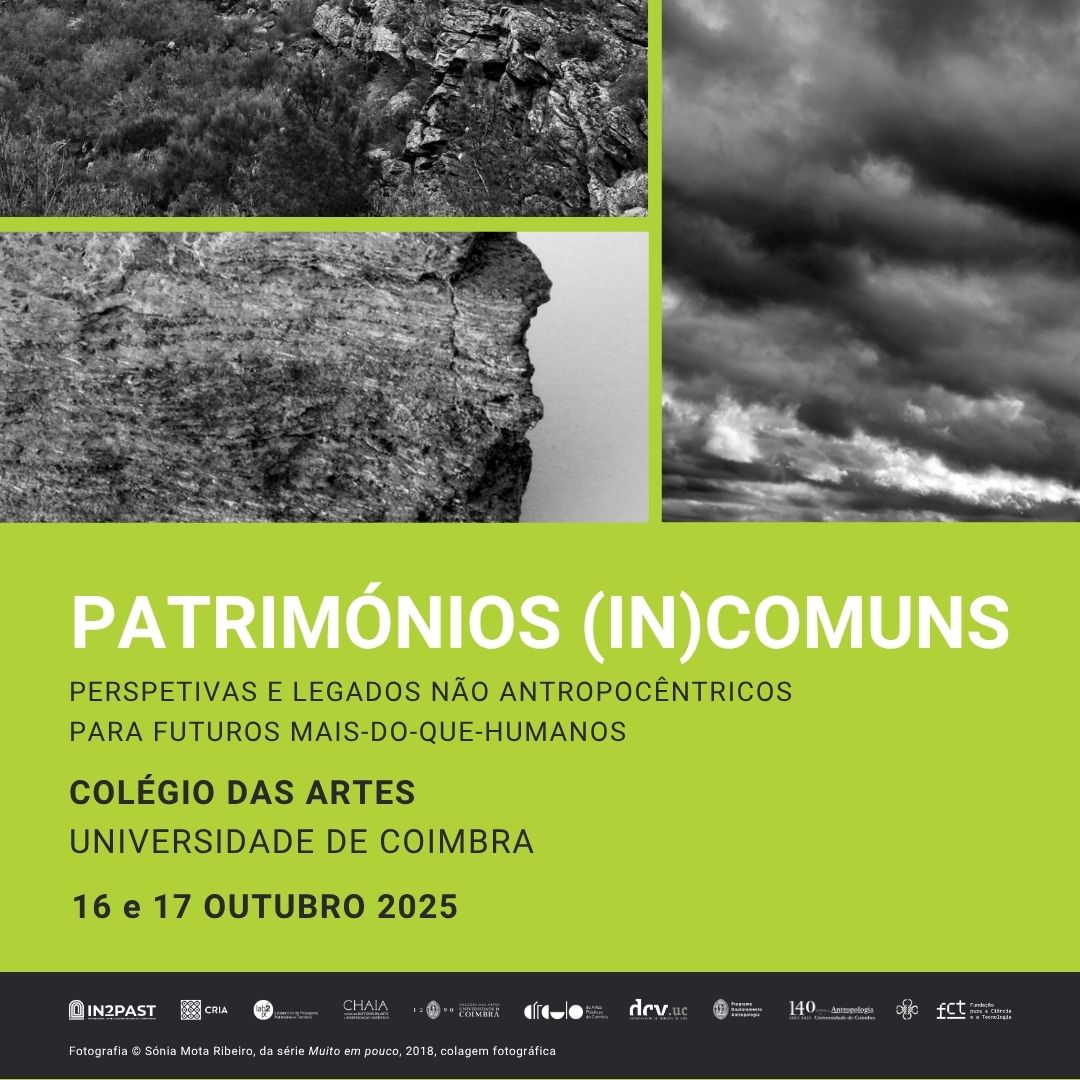
Photograph © Sónia Mota Ribeiro, from the series Muito em pouco (‘Much in little‘), 2018, photographic collage.
With the growing impact of human activities on climate and ecosystems, and the processes of environmental degradation, which threaten the lives of several species, including our own, disciplinary boundaries and between different fields of knowledge are breaking down and being redefined. The Anthropocene ends the distinction, fundamental to modern epistemologies and ontologies, between the cosmological and anthropological order, between nature and humanity (Latour 1994, 2017; Danowski and Viveiros de Castro, 2015; Tsing, 2019).
Climate and environmental catastrophes (droughts, floods, fires, biological extinctions, contaminated water) intrude on the human world and other more-than-human entities (forests, rivers, plants, animals, rocks, atmospheric agents) become historical actors and political subjects, which the social sciences and humanities can no longer ignore (Danowski and Viveiros de Castro, 2015; Tsing, 2015, 2019; Descola, 2022). Geopolitics and geophysics, human histories and natural histories articulate themselves.
This IN2PAST Meeting aims to convene and provoke multiple dialogues between the humanities and natural sciences, between the sciences, arts and architecture, between knowledge generated in academia and outside it, on more-than-human landscapes, in different times and places.
Following studies in the 1980s and 1990s on landscape as text, image, representation, and symbol, the materiality of landscape has been recovered with the so-called ‘ontological turn,’ which questions human exceptionalism and the Great Divide between the domains of nature and culture (Latour, 1994).
New studies on landscape open space for more-than-human socialities and show how animals, plants, rocks, and atmospheric agents are our companions in the process of inhabiting and making worlds. Landscapes are formed by multispecies assemblies and non-living materials, by intentional and unintentional human and non-human actions, by historical intertwining, presenting themselves, according to Anna Tsing, as ‘concrete sediments of vital flows, atmospheric conditions, dreams, memories, and representations’ (Cardoso and Devos, 219: 9).
For Tsing, despite or because of the modern dream of human control over ‘nature,’ new feral ecologies emerge in the Anthropocene, ecologies formed by non-human’ unintended reactions to human infrastructures, mostly socially, culturally, and ecologically destructive, but also those that present themselves as avenues of hope, forms of resistance, of humans and non-humans, and ways of imagining other possible futures for landscapes in ruins.
It is through this challenging conceptual overview, within the realm of the more-than-human, that we propose to reflect. The concept of heritage is thus problematised from other perspectives that not only decentre it from exclusively human, social and cultural legacies and appropriations, past and present, but also force us to think about an idea of a shared future constituted and constitutive of multiple biotic and abiotic connections. We are referring to a heritage that is common to all, albeit with territorial and cultural inscriptions that are administratively and politically managed.
The sky, the atmosphere, the sea, water, the earth, soil, wind, air, mountains and stones, among so many other elements on which we all depend and whose appropriation in terms of heritage (possession and ownership) can endanger human lives and the ecological balances, necessary for the planet’s existence, without caring for it as a common heritage (belonging to everyone, including everyone else and everything else beyond humans).
The programme for the Meeting includes communications and presentations of research projects, a workshop, installations, performative lectures and the presentation of a multimedia platform.
October 16 (Thursday)
2 pm | Meeting Opening
2:30 • 3:20 pm \ Climate change: Open Talk with Carlos
da Câmara and Paulo Magalhães
Carlos da Câmara (Instituto Dom Luiz, Universidade de Lisboa) • Paulo Magalhães (CIJ – Centre for Interdisciplinary Research on Justice, University of Porto / Common Home of Humanity) • Host: Paulo Mendes (CRIA – University of Minho / IN2PAST)
3:30 • 4:20 pm \ Aspects of a politics of the sensitive for more-than-human landscapes
Dirk Michael Hennrich (Centro de Filosofia da Universidade de Lisboa) • Host: Humberto Martins (CRIA – University of Minho / IN2PAST)
5 pm • 5:50 pm \ Ecologies of Passage
Miguel Duarte (Lab2PT – University of Minho / IN2PAST) •
Host: Pedro Guilherme (CHAIA – University of Évora / IN2PAST)
6 pm \ Vago_mundo
Marcelo Moscheta (College of Arts, University of Coimbra) • Host: Humberto Martins (CRIA – University of Minho / IN2PAST)
October 17 (Friday)
10 • 10:50 am \ The history of fire and fire in history: concepts,
methods and results of the FIREUSES project – Landscapes of Fire
Miguel Carmo (Institute of Contemporay History – NOVA FCSH / IN2PAST) •
Host: Sónia Mota Ribeiro (CRIA – NOVA FCSH / IN2PAST)
11 am • 11:50 am \ From traffic to transition: streets for a shared habitat
Ivo Oliveira (Lab2PT – University of Minho / IN2PAST) • Host: Rebeca Blanco-Rotea (Lab2PT – University of Minho / IN2PAST)
12h • 12h50 \ A bombastic talk about communities around plants and their pollinators: the Monte Formoso Garden and São Flores initiatives, Coimbra
Catarina Maia (Projects Jardim Monte Formoso and São Flores, Coimbra, coordinator) • João Loureiro (Centre for Functional Ecology / Life Sciences Department, UC) •
Host: Sandra Xavier (CRIA – University of Coimbra / IN2PAST)
Note: Only 15 people may take part in the workshop, but anyone interested can participate in the conversation at the same time.
13h \ Lunch
2:30 • 3:20 pm \ Regeneration and revolution: removing earth and revealing images of the Alentejo ‘montado’
Daniela Rodrigues (ANFAA – Amidex / IDEAS – amU) •
Host: Sónia Mota Ribeiro (CRIA – NOVA FCSH / IN2PAST)
3;30 • 4:20 pm \ Metabolic vertigo. Untimely meditations on plastics, commodities, ontologies, and other fetishes
António Pusceddu (CRIA – Iscte / IN2PAST) • Host: Rui Llera Blanes (CRIA – Iscte / IN2PAST)
4:30 • 5:20 pm \ Embracing Landscapes
Selcen Küçüküstel (CRIA – Iscte / IN2PAST) • Host: Rui Llera Blanes (CRIA – Iscte / IN2PAST)
5:30 pm \ Closing – Collective installation ‘Remains/Traces’ (‘Restos/Rastos’)
All participants • Désirée Pedro and Carlos Antunes (Department of Architecture, University of Coimbra) • Paulo Raposo (CRIA – Iscte / IN2PAST)
Ana Moya (CHAIA – University of Évora / INPAST)
Humberto Martins (CRIA – University of Minho / IN2PAST)
Paulo Mendes (CRIA – UMinho / IN2PAST)
Paulo Raposo (CRIA – Iscte / IN2PAST)
Ruy Llera Blanes (CRIA – Iscte / IN2PAST)
Sandra Xavier (CRIA – University of Coimbra / IN2PAST)
Sónia Mota Ribeiro (CRIA – NOVA FCSH / IN2PAST)
Rebeca Blanco-Rotea (Lab2PT– UMinho / IN2PAST)
Humberto Martins (CRIA – University of Minho / IN2PAST)
Paulo Mendes (CRIA – UMinho / IN2PAST)
Paulo Raposo (CRIA – Iscte / IN2PAST)
Ruy Llera Blanes (CRIA – Iscte / IN2PAST)
Sandra Xavier (CRIA – University of Coimbra / IN2PAST)
Sónia Mota Ribeiro (CRIA – NOVA FCSH / IN2PAST)
Sandra Xavier (CRIA – UC / IN2PAST)
João Marto Pereira (MAGAC, DCV – UC)
Joel Gregório (MAGAC, DCV – UC)
Filipe Olival (CRIA – UC / IN2PAST)
Luís Quintais (Colégio das Artes/ DCV – UC)