
The call for papers for IFPH 2026 Lisbon: 8th International Conference on Public History is now open, until November 30, 2025. Organised by the International Federation for Public History (IFPH), it will take place in Lisbon from September 7 to 11, 2026. The conference will be hosted by IN2PAST – the Associate Laboratory for Research and Innovation in Heritage, Arts, Sustainability and Territory, a transdisciplinary consortium of seven research centres, at Colégio Almada Negreiros on the Campolide campus of Universidade NOVA de Lisboa.
Dedicated to ‘The Public History of Difficult Pasts’, the IFPH’s 8th Conference seeks to challenge historical revisionism, amplify marginalised voices, and foster transnational dialogues on reconciliation, accountability, and restorative justice, inviting contributions that explore one of more than 25 subtopics on the themes of Historical Contexts and Global Processes, Contemporary Challenges and Methodological Innovations, Voices and Perspectives, and Justice and Reconciliation.
The deadline for application to this call is the 30th November 2025 and the review process shall be completed by 31st January 2026, followed by a call for posters in the same month. You can find the full call text, conference calendar, and submission guide and links below. The call text is also available in PDF format, and elsewhere in the cloud at https://tinyurl.com/ifph2026lisbon-call.
IN2PAST is represented on IFPH’s Steering Committee by IHC – NOVA FCSH researcher Joana Dias Pereira.
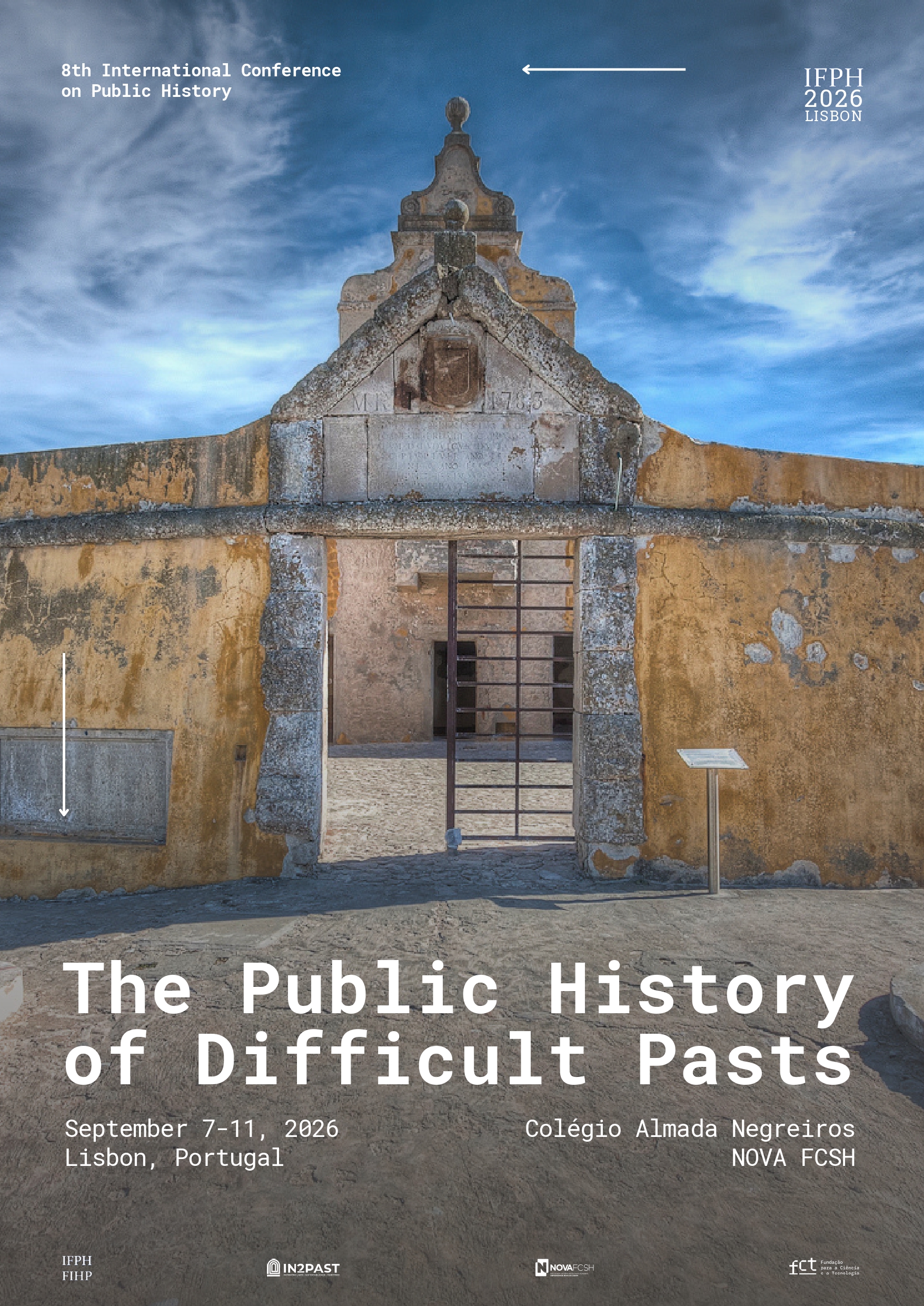
Photograph: Peniche Fortress, Fortim Redondo, site of the infamous ‘Segredo’ (isolation cells) © Paulo – Flickr (CC BY-NC-ND 2.0)
The 8th International Conference on Public History, organised by the International Federation for Public History, IFPH, will take place in Lisbon from September 7 to 11, 2026. It will be hosted by IN2PAST – the Associate Laboratory for Research and Innovation in Heritage, Arts, Sustainability and Territory, a transdisciplinary consortium of seven research centres, at Colégio Almada Negreiros on the Campolide campus of Universidade NOVA de Lisboa.
In a time of escalating attacks by right-wing movements on memory, diversity, human rights, democracy, and history itself, the International Federation for Public History (IFPH) reaffirms its commitment to fostering critical engagement with the ways societies confront, interpret, and relate to their difficult pasts and challenging presents. The IFPH strongly condemns book banning, the censorship of historical narratives, the surveillance of students and educators, the targeting of sites of remembrance, and the imposition of ideological agendas — particularly right-wing distortions — that not only threaten academic freedom but undermine the very principles upon which public history is built. Against this backdrop, the conference seeks to challenge historical revisionism and silencing, to amplify marginalised voices and memories, and to promote transnational dialogues on reconciliation, accountability, and restorative justice.
Public History has long addressed global historical processes such as colonialism, the transatlantic slave trade, and the genocide of Indigenous peoples, as well as phenomena that emerge in multiple contexts, including armed conflicts and dictatorships. It embodies both a political and ethical commitment to examining how difficult pasts have been lived and remembered by different communities and individuals, ensuring that their perspectives are acknowledged and respected. At the same time, engaging with these histories through Public History raises significant challenges. Sharing authority with specific communities and amplifying marginalised narratives may unintentionally silence other voices, while also presenting complex ethical dilemmas.
Furthermore, Public History operates within the public sphere, engaging diverse audiences and navigating competing representations of the past in an era increasingly marked by the political instrumentalisation of history and the spread ofrevisionist and denialist discourses.
This conference seeks to challenge historical revisionism, amplify marginalised voices, and foster transnational dialogues on reconciliation, accountability, and restorative justice. We invite contributions that explore:
Historical Contexts and Global Processes
Contemporary Challenges and Methodological Innovations
Voices and Perspectives
Justice and Reconciliation
Guide for Submitting a Proposal
Submit an Abstract
Your abstract should be 300 to 500 words long for all types of proposals. Please identify the core issues or questions that your proposal addresses. Explain your approach, use, and/or practice of public history. Briefly present, if applicable, the different presentations and how they connect with your main themes and questions.
Choose a Type of Proposal
Submit your panel proposal here.
Submit your paper proposal here.
Submit your Working Group proposal here.
CALENDAR
Opening of the Call for Presentations: 30th September 2025
Deadline for Application: 30th November 2025
Deadline for reviewers to do their reviews: 31st January 2026
Call for posters: January 2026
Results of the Call for Presentations will be announced by March 2026
Programme of the conference shall be available around June 2026
Deadline for registration for on-site attendance: August 2026
Conference: 7-11 September 2026